Answer a bad review calmly. Never pay, threaten or accuse.
A genuine complaint gets a short, calm reply. A sudden pile of one-star reviews followed by a demand for money may be a scam, and Google says not to pay.
A customer posts a bad review of your business on Google or on Yelp, the review website. If the complaint is genuine, answer it. Write for the next person in East Hampton, Middle Haddam or Cobalt who looks you up. Google posts your reply directly under the review, as the business, without your personal name.
Google’s tips: keep it short, apologize when it fits, and admit a mistake you made without taking the blame for things outside your control. If the problem is complicated, Google suggests asking the reviewer to reach you by phone or email. Staff at the Federal Trade Commission, the agency that enforces the law against unfair or deceptive business practices, say its review rule (see No. 13) does not bar contacting a reviewer to resolve a problem.
Where to reply. On Google, go to your Business Profile, the listing that shows your business on Google. Select Read reviews, then Reply next to the review. Google checks every reply against its content policies first, usually within 10 minutes but sometimes up to 30 days. A reply that fails comes back to you to edit.
On Yelp, you need an approved profile photo and business account name to respond. Open Reviews in the left-hand menu of your business account (in the app, More, then Reviews). You can use Respond, a public reply shown under the review, Direct Message, a private note, or both. Yelp’s help article recommends starting with Respond. Its posting rules, though, say a direct message is often the best way to resolve a dispute.
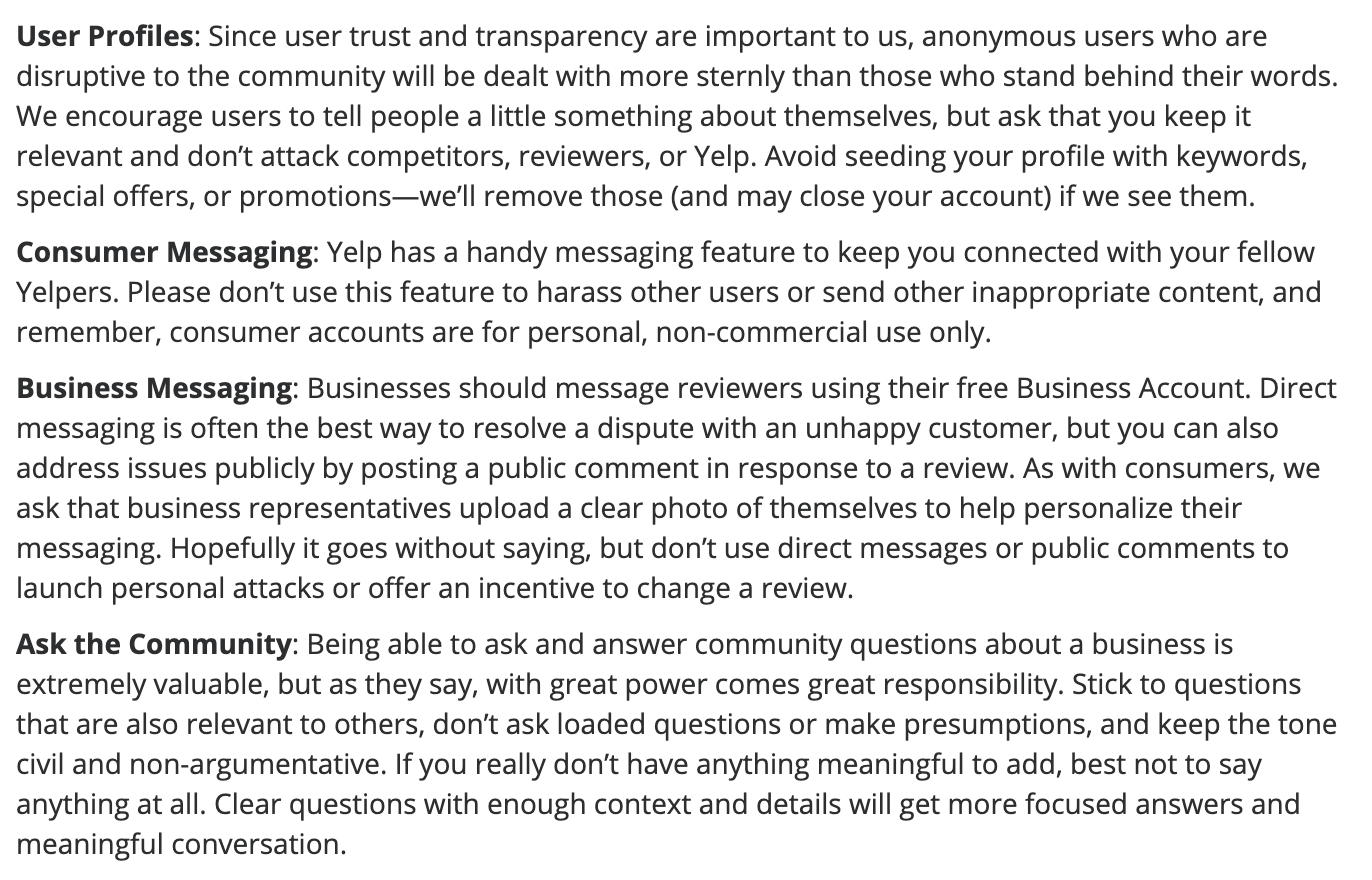
Four things a reply may not do, and whose rule says so:
- Attack the reviewer. Google and Yelp both forbid personal attacks, and Yelp’s ban covers direct messages too. Google also bars sharing a reviewer’s private information.
- Offer something to change or remove the review. Google strictly prohibits payment, discounts or free goods or services in exchange for a changed or removed review. Yelp bans rewards to change or remove one, and says it puts a pop-up alert on the business’s page when it learns of such offers. The federal rule doesn’t cover this, but FTC staff say paying to change or remove a truthful negative review “may violate the FTC Act as an unfair or deceptive act or practice.”
- Threaten or accuse. The federal rule bans using an “unfounded or groundless legal threat,” a physical threat, intimidation, or a public accusation that is knowingly false, or made without caring whether it’s true, to stop a review or get one removed.
- Advertise. Google says to leave deals and promotions out of replies. Yelp says owner comments shouldn’t advertise.
Our advice: neither Google nor Yelp addresses a refund or redo you would offer anyway, whatever the review says. Make any such offer by phone or private message, apart from the review, since one that arrives right after a bad review can look tied to it.
The scam. Google warns of an extortion scheme. It may start with a sudden run of 1-star and 2-star reviews on your Business Profile, followed by someone demanding money, goods or services to remove them. Google says not to engage with or pay the people behind it, because that can encourage more attempts and “doesn’t guarantee the removal of reviews.” Don’t try to settle it yourself with money or services. Report it on Google’s merchant extortion report form, with screenshots of the demands.
Before you post a reply, reread it against the four rules above. Take out any customer detail, any offer and any argument.
The Standard: Answer the complaint, not the person, and never offer anything to change or remove the review.
Source: Google Business Profile Help, “Manage customer reviews,” “Tips to get more reviews” and “Report negative review extortion scams”; Google Maps content policy; Yelp Business Help Center, Content Guidelines and “Don’t Ask for Reviews”; FTC reviews rule (16 CFR 465.7) and staff Q&A. Read Sept. 25, 2026.